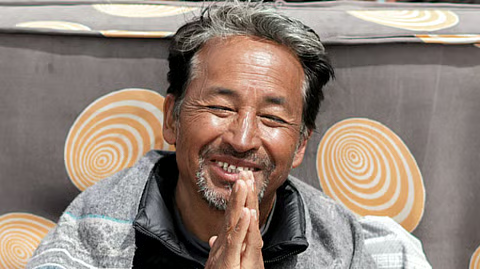

The legal struggle surrounding the detention of prominent climate activist Sonam Wangchuk has reached the Supreme Court of India. His wife, Gitanjali Wangchuk, has filed a petition challenging his continued detention under the stringent National Security Act (NSA), escalating the high-profile legal battle against the state authorities.
The development comes months after the Ladakh-based environmentalist, whose work inspired the film 3 Idiots, was detained following his protest fast. Wangchuk had been advocating for constitutional safeguards for Ladakh—specifically the inclusion of the Union Territory under the Sixth Schedule—to protect the region’s fragile environment and indigenous culture.
Fundamental Rights vs. National Security
Gitanjali Wangchuk’s plea argues that her husband’s detention under the NSA is unwarranted and represents a severe violation of his fundamental rights, including the right to protest peacefully. The core of the petition questions the state’s use of the NSA—a law designed to prevent threats to national security—against an activist whose actions were non-violent and centered on demanding constitutional provisions.
The petition forces the Supreme Court to critically examine the line between legitimate democratic dissent and actions that can justify invoking a law as powerful as the NSA. Supporters of Wangchuk, including local communities and environmental organizations, maintain that the detention is a deliberate attempt to stifle criticism regarding the region’s development policies and political autonomy.
Implications for Peaceful Activism
The Supreme Court’s decision in this case will carry significant weight. A ruling in favor of the petition could reinforce the boundaries of the state’s power under the NSA and reaffirm the right of citizens to protest over critical environmental and political issues, particularly in ecologically sensitive areas like the Himalayas. The hearing is expected to draw national attention as it addresses core questions about civil liberties and political activism in India.