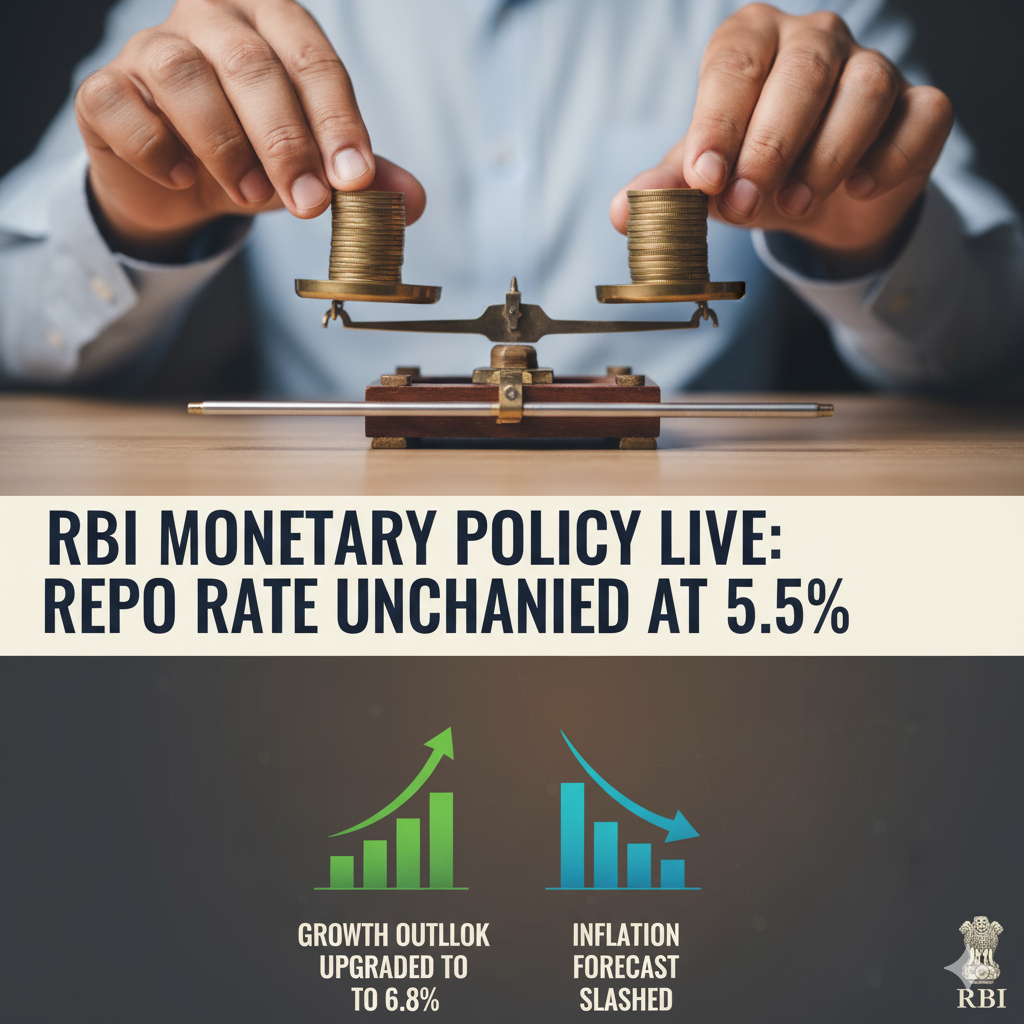

RBI Holds Key Rate Steady at 5.5% as Global Headwinds Dictate Caution
The Reserve Bank of India (RBI) has announced its decision to keep the crucial repo rate unchanged at 5.5% following the conclusion of the three-day Monetary Policy Committee (MPC) meeting. This move, which was widely anticipated by analysts, marks the second consecutive pause since the central bank delivered a cumulative 100-basis-point (bps) reduction earlier this year. The MPC has also unanimously resolved to maintain its ‘Neutral’ monetary policy stance, signaling a strategic pause to observe the evolving domestic and international economic landscape.
What the Rate Stability Means for Your Finances
For the average consumer, this policy continuity translates directly into stable borrowing costs. The decision to hold the repo rate steady means that Equated Monthly Instalments (EMIs) on repo-linked home loans, car loans, and personal loans will remain constant, offering much-needed predictability for household budgets. This stability allows borrowers to fully benefit from the significant rate cuts that were implemented across the first half of the year. Conversely, the trend of falling Fixed Deposit (FD) interest rates is also likely to slow down, offering existing savers a window of opportunity to lock in rates at current, relatively higher levels. For India’s real estate sector, the stable interest rate environment is expected to sustain positive buyer sentiment, particularly during the ongoing festive season.
Key Economic Drivers and Forward Outlook
The MPC’s decision is rooted in a careful analysis of the growth-inflation dynamic. On the domestic front, the RBI expressed confidence in the nation’s economic resilience, citing robust consumption and government capital expenditure. This optimism was reflected in a significant upward revision of the GDP growth forecast for the current fiscal year (FY26) to 6.8%, up from the earlier projection of 6.5%. Furthermore, the inflation picture is comfortable; thanks to favorable food prices and the positive impact of recent GST rate rationalization, the RBI has slashed its CPI inflation projection for FY26.
Despite strong domestic performance, the ‘Neutral’ stance remains critical. The RBI is explicitly factoring in persistent global headwinds, including geopolitical risks and increasing trade uncertainties, which pose a downside risk to exports and overall growth in the latter half of the fiscal year. By keeping the policy rate on hold, the central bank preserves its “optionality,” enabling it to swiftly pivot towards further rate cuts should growth slow unexpectedly, or to address any unforeseen spike in inflation, ensuring that monetary policy remains flexible and data-dependent.